Science
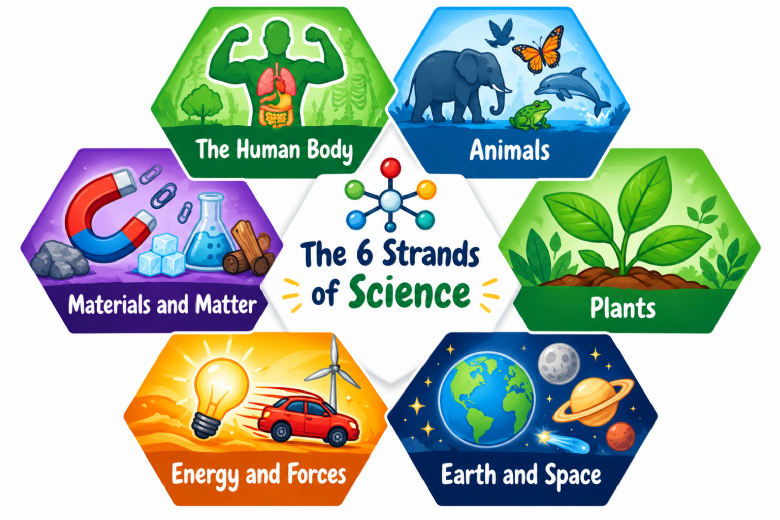
At St George’s, Science is taught through an ambitious, carefully sequenced and knowledge-rich curriculum, organised into six interconnected strands: Animals, Plants, The Human Body, Materials and Matter, Energy and Forces, and Earth and Space. Learning is designed to build progressively from EYFS to Year 6, enabling pupils to develop secure scientific understanding, make meaningful connections and become curious, confident young scientists.
Our curriculum prioritises essential ‘sticky knowledge’, ensuring that all pupils, regardless of their starting points, can access, retain and apply key scientific concepts. Regular retrieval practice strengthens long-term memory, while the explicit teaching and revisiting of scientific vocabulary enables children to explain their thinking, ask questions and communicate confidently using accurate scientific language.
Practical enquiry is an integral part of our approach, with Working Scientifically skills embedded throughout the curriculum rather than taught in isolation. Investigations are purposeful and carefully linked to the knowledge being taught, providing opportunities for pupils to make predictions, explore scientific ideas, interpret results and deepen their understanding of the world around them.
Science learning extends beyond the classroom through outdoor exploration, educational visits, Science Week and engagement with external visitors. These experiences enrich pupils’ scientific understanding, develop their science capital and inspire a lifelong curiosity about the natural world. Rooted in our Catholic ethos, our approach also encourages pupils to appreciate the wonders of creation and recognise their responsibility as stewards of the world around them.